LOGO Vector RMC

Storage Fires

Storage Fires

Understanding the Risk

Many of the most costly fires occur in warehouses and storage areas, where often a high fire risk is combined with high values and/or a high business dependency.

In recent years the fire risk associated with warehouses and storage areas has been enhanced by the increasing use of combustible packaging, including expanded plastics and the move to ever larger and higher warehouses with increasing levels of automation and limited compartmentation.

Controlling the hazard

In order to effectively control the fire hazard associated with warehousing and storage it is necessary to have in place an effective combination of both human element and physical protection controls.

Human Element controls relate to the management procedures aimed at reducing the likelihood of a fire occurring and ensuring an effective response in the event of a fire.

Physical Protection controls relate to protection or design principles aimed at reducing or mitigating the effect in the event of a fire.

The issues detailed under these 2 headings should be considered fully, to create an integrated storage risk control programme.
Human Element
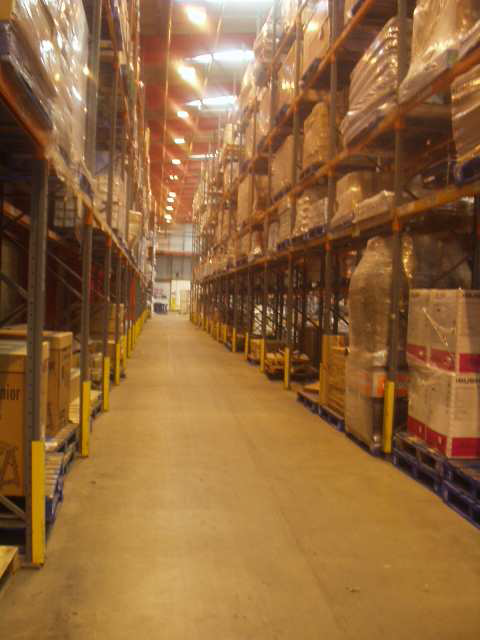
  • Establish effective housekeeping arrangements to ensure that clear aisles are maintained at all times and prevent buildups of combustible waste inside the warehouse / storage area.

  • A system of regular self-inspections should be established to ensure that housekeeping disciplines are being maintained and that fire protections remain in place and fully functional – weekly inspections are recommended.

  • External combustible storage should be undertaken as far away as possible from the outside of the buildings, to be no nearer than 10m.

  • Ensure that adequate smoking controls are in place and are fully complied with.

  • All hot work should be the subject of an adequate permit to work system – further guidance can be found in the RMC Insight document on Hot Work.

  • Where automatic sprinkler protection is installed it is essential that adequate clearance is maintained between sprinkler heads and the top of the stored goods below.

  • Stock should be stored at least 150mm clear of the floor to prevent damage from water.

Physical Protection
  • Warehouse and storage buildings should preferably comprise detached buildings with adequate spatial separation from adjacent buildings. Where this is not practicable warehouse and storage areas should be effectively fire separated from all adjacent areas in particular production areas.

  • Construction of the warehouse / storage area should be of non-combustible materials including walls, roof and floors. In connection with the use of composite metal panels these should be insulated with noncombustible materials. Exposed structural steelwork should preferably be fire protected to prevent premature collapse.

    Storage Fires RMC_INSIGHT
    • Internal fire walls between adjacent warehouse / storage areas and between warehouse / storage areas and production areas should be of at least 4 hours fireresistance or 2 hours where the areas on both sides of the wall are adequately sprinkler protected.

      A clear area of at least 2m should be maintained on both sides of all fire doors.

    • Hazardous operations e.g. forklift truck battery charging etc should be adequately separated from the main warehouse / storage area, preferably by fire walls of at least 2 hours fire-resistance.

    • The use of high intensity discharge lighting inside warehouse / storage areas should be avoided unless they have a non-combustible external containment barrier enclosing the whole of the lamp unit.

    • Light fittings should be sited over aisles and clear of stock.

    • Heaters should be preferably of the fixed black heat type sited at least one metre clear of stock and where floor mounted within a substantial fixed metal barrier.

    • Warehouses and storage areas should be fully protected by an adequate automatic sprinkler system.

    • Where smoke vents are required they should be preferably under manual control. Automatic operation of smoke vents should be interfaced with automatic fire protection systems in particular automatic sprinkler systems to ensure that their operation is not impaired.

    For further information, please contact your RMC Engineer

    Download